This post details my first stakeholder interview and conversation with project founder Simon Galperin.
I asked Simon about the evolution of their current process along with their software tools and setup.
They now scan over 200 sources per weekday to produce the Daily Bulletin. Currently a mix of RSS feeds, email newsletters, social media activity, various online websites and portals, and more. For news items they decide to include, they rewrite the headlines, do some general categorization and put them into a holding queue. This process, which they refer to as the “news harvest,” is all managed through a central Google Spreadsheet that is populated through a combination of software tools (e.g. a Chrome extension that can be opened while on a web page of interest, which in turn sends that information to Zapier, which then adds the information to the Google sheet) and manual entry.
Once the news has been harvested, they again use software tools to publish it to various distribution channels, including a WordPress-powered website, social media accounts, and an email newsletter distributed by Mailchimp.
Some additional follow-up information about news items becomes available after initial publication, such as video transcripts that come in from a third-party transcription service.
They sometimes also do original reporting which is posted on their WordPress site and then linked to in the bulletin.
Simon described the process as a prototype that is ripe for expansion and hopefully reuse in other communities. Simon emphasized that at its core, the goal of the process is to make sure the news being reported is representative of the entire community, and can be open to contributions and insights from people who may be traditionally excluded from the news gathering and community information distribution process. They also want to help people move past information overload while continuing to encourage community engagement. They make sure the sources are always cited and that they’re sharing information of practical value to residents and readers.
I asked Simon to say more about how they were exploring expansion and possible re-use of this toolset.
This effort is driven by the mission of the Community Info Coop, “making journalism and media more representative of the people it serves. We equip communities with the tools and information they need to design and sustain news and information ecosystems that strengthen democracy and increase civic engagement.”
Simon collaborated with Mario Vasilescu and the team at Rewordly to scope out a potential platform that would help accomplish this (they refer to it as “Represented”), powered by the news harvest methodology.
From information Simon provided later:
Represented uses new approaches to uplift local storytelling and increase civic participation. The result is a more sustainable model for news production which helps communities be better represented and more resilient.
It follows and expands on the “news harvest” methodology developed by the Community Info Coop through the Bloomfield Information Project. This process has led the Coop to increase the quantity and quality of civic information in Bloomfield with more than 1 in 2 of the dozens of local news items we share weekly coming from informal news providers posting in channels we monitor.
Represented will not only further automate this process, but also create new ways of soliciting news from the local community and engaging them directly via an owned platform.
Represented’s unique model makes this all possible through four components: the community contribution system, the “harvest” dashboard, the community social news board, and the community engagement marketplace. These components include a mix of technological, editorial, engagement, and business model innovation, as outlined below.
The general concept is to build a toolset that would allow other communities to implement a similar news harvest process, and then have the flexibility to distribute that information through any number of channels: websites, social media, texting, audio, video and others. The end result is a community-driven social news hub, with integration and outreach layers that encourage participation from everyone.
Simon and Rewordly explored a few avenues for pursuing this. One recent one was a grant application for funds to pay a developer to build this re-usable set of tools, but the grant did not come through. As a part of planning for the grant they’ve talked in depth with at least one development firm, to the point of creating some mockups and plans for the eventual product to be built.
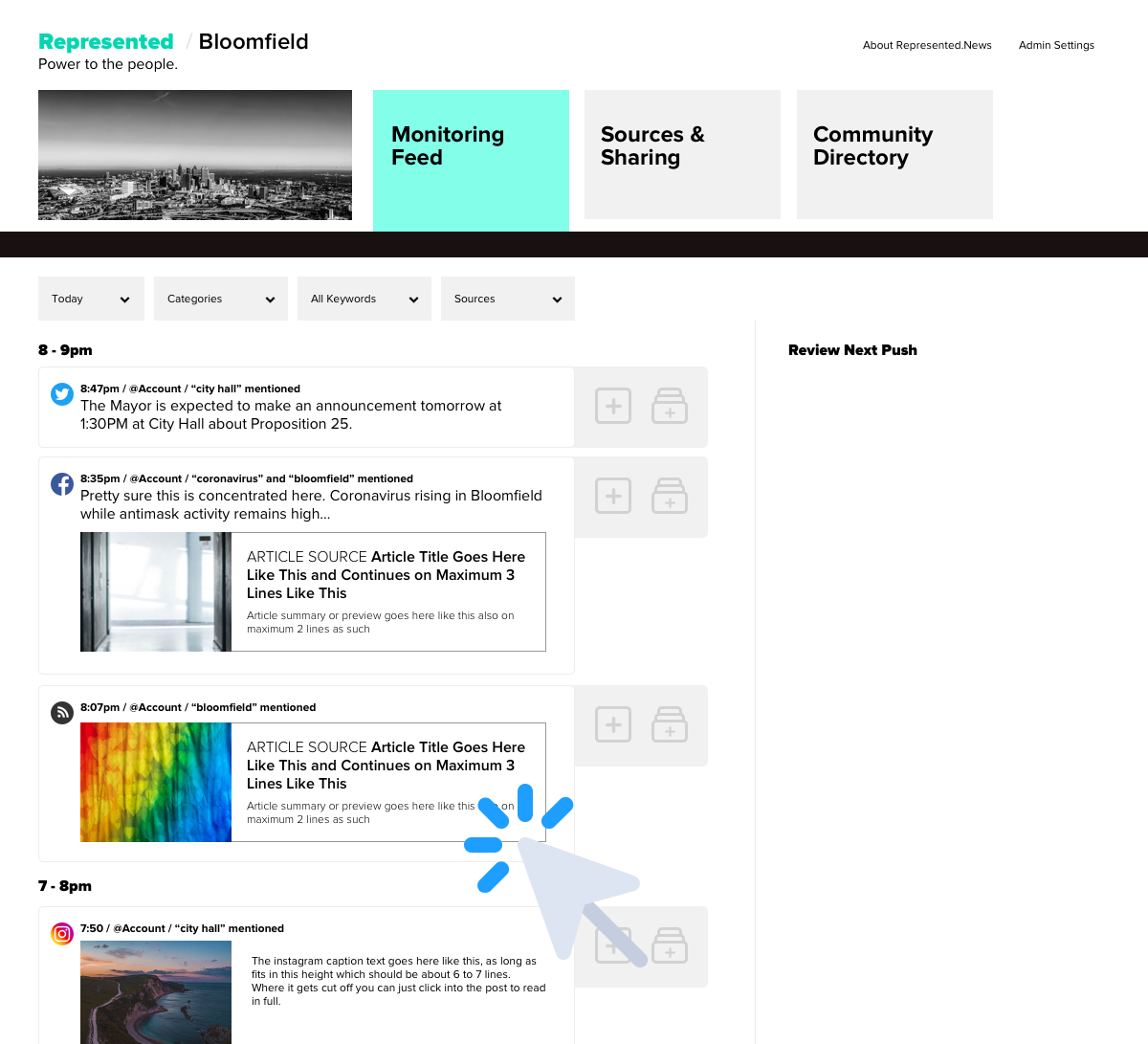
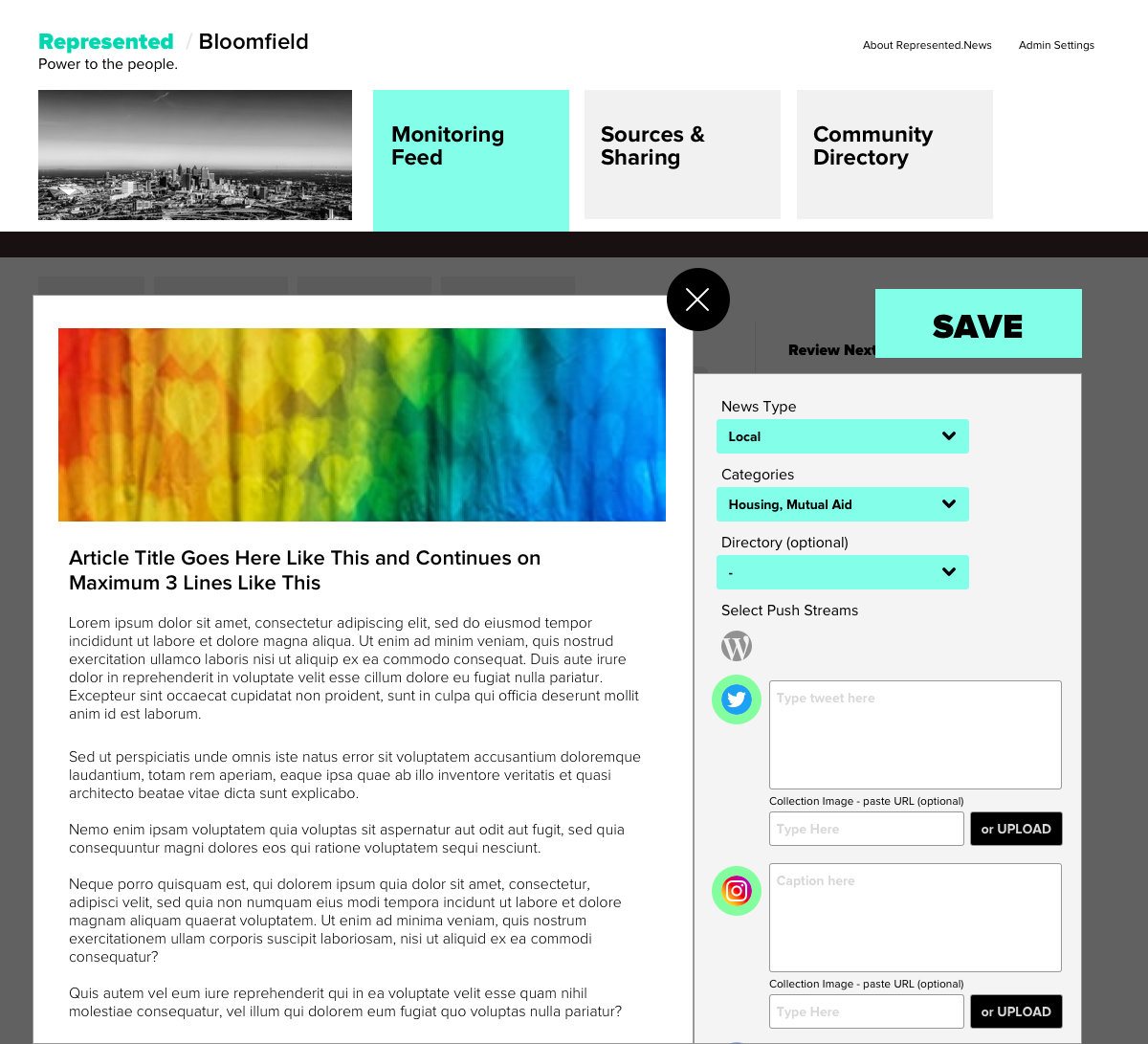
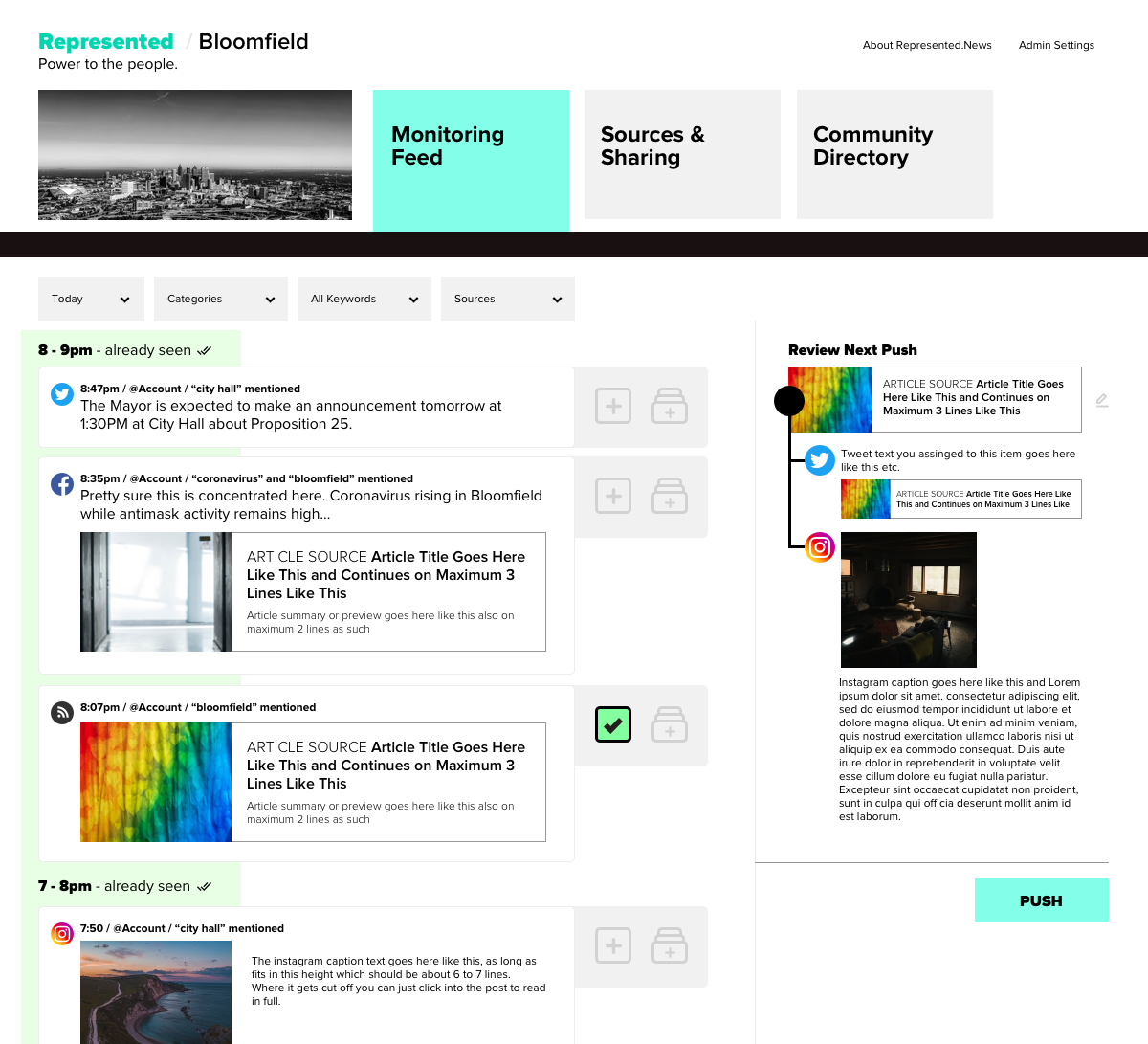
Inpsirations mentioned included Current Status, EveryBlock (now defunct), WTF Just Happened Today? and the Documenters Project.
Simon is exploring and thinking about other related possibilities like a Documenters-style assignment desk for covering local government meetings and other topics, providing trainings to community members, more inclusion of local events, job postings, a community directory, a community wiki, maybe a retail storefront.
I asked Simon to talk about the funding and revenue model for the project.
To date it’s been primarily funded through grants and community donations while establishing proof-of-concept. The hope and plan is to show the model is viable and then implement other revenue streams including:
- Direct audience revenue such as donations, product subscriptions or memberships. Membership tiers could unlock additional features or sponsorship opportunities.
- Allowing businesses and individuals to sponsor rewards and stipends for community member participation. Members may be able to access in-kind perks offered by local businesses by redeeming points related to their contributions to the local news ecosystem.
- Institutional sponsorships from keystone institutions like hospitals, schools, libraries or business associations.
- Eventually, as a comprehensive community news platform, they could potentially pursue local government contracts to serve as a clearinghouse for public information.
We discussed some of the challenges, limitations and missing pieces from the current setup.
- The current news harvest process is very time intensive and dependent on the availability of the small number of people involved. Every little optimization to tools and workflows can save lots of time when added up over the days.
- The absence of Spanish language translation, automated or manual or both, is notable.
- There’s interest in managing subscriber submissions and more feedback channels beyond the social media channels they currently monitor, but not enough capacity to process those.
- Some of the automations are a bit brittle and/or slow in the way they require copying and pasting, typing something out, manually initiating steps, reviewing, etc.
- In an emergency situation, the ability to use SMS to distribute info about access to food, aid, emergency management updates, etc. would be very important.
- The current process is very dependent on Crowdtangle for accessing and processing content being shared on Facebook, and that tool may not be available forever or allow that kind of use forever.
We discussed some technical challenges and opportunities I could possibly help with as a part of my capstone project. These ideas came up:
- Generate RSS feeds for sources that don’t offer them
- Keep better track of what links are being clicked within each Daily Bulletin email
- Work on a basic news/information submission form on the WordPress site
- Set up an internal (or even public) wiki to start documenting processes, guidelines, ideas, organizational history
- Auto-generate a draft Mailchimp campaign for the daily newsletter.
- Get social media embeds working when a social item is published on WordPress
- Create a browser sidebar extension to replace the current Zapier one
- Automated (or human-supported) tagging or categorization that enables self-sustaining landing pages – events, schools news, health and safety, etc. Sort of like beats/sections but populated by the news harvest instead of a dedicated reporter all of the time.
- Try to automatically scrape public meeting notices from the press association website
- Community knowledge base development supplemented by the automated tagging above – including wiki-style articles, sections, glossary, etc.
- Build a Minimum Viable Product version of the Represented News Harvest Dashboard
- Automate the process of bringing public meeting videos posted on Facebook into a single page view that combines the video, the Otter-generated transcript, and other related info
After our conversation, I made these notes and initial analysis:
- Really neat to learn about what they’re doing and the level of imagination, resourcefulness and creativity in the project’s work. Seems like stuff that other communities frequently get stuck on, so would be awesome to see them meet the goal of expanding and reproducing this model.
- It sounds tough to figure out the right balance of maintaining and improving the existing workflow against pursuing a new workflow and toolset that could dramatically improve their daily work.
- The existing tech stack is impressive in the ways they are making it work for them. Some concerns about how fragile it might be if a given tool stops working, and some places where information is being duplicated, but overall it’s really neat!
- There are so many different directions that my work could go in for a capstone project, and all of them are exciting, so the challenge will be finding a scope of work and engagement that feels achievable at a high level of quality, and that doesn’t depend too much on Simon and team’s availability on any given day given everything else they have going on. At the same time, I want to stay flexible and adaptable to keep with the iterative and experimental nature of the project.
- Ideally I can contribute to some smaller “quality of life” improvements with their initial toolset and then spend a larger chunk of time on launching a new foundation they can build on for the long term.
