Final capstone write-up and video

On Monday June 13, I defended my capstone project in a meeting with the advisory committee and today, June 16, I submitted the final write-up for sign-off by the Graduate School.

Here’s the final capstone project document in PDF format.

I also created a 10 minute video that walks through the project:

Capstone project overview

(A correction to the video narration: the Bloomfield Information Project was founded in 2020, not 2022.)

Finally, here are the software repositories mentioned in the write-up and video:

I’m of course very excited to be at this milestone. I offer my thanks and appreciation to everyone who contributed to or supported this project in some way, and to my advisory committee for their guidance and feedback.

I’ll plan to leave this site up for the near future, and have preserved a static HTML version of it for the future in the event that I take down the live version.

Status update for May 2

Following up on previous updates (April 1, Feb 28), here’s another summary of what’s been unfolding with my capstone project work:

Progress

 Plans

  • Per the original project timeline, I’ll be shifting in to compiling and writing up summaries, analysis, project reviews and related discussion, as well as creating a video walkthrough or presentation, as a part of the final project deliverables.
  • As needed, I’ll make myself available to Simon and team for continued refinements or questions about the tool as they increase their usage of it in the daily news harvest workflow.

Problems

  • Carried over from last month, the Bloomfield team has had some challenges locating and contacting additional stakeholders for me to interview (at least one representative reader of the Daily Bulletin, and one person who has provided financial support to the project). Still hoping and expecting to be able to complete these conversations soon.

Testing feedback and refinements

Since delivering the tool I’ve built to Simon and his team for testing, we’ve spent the last few weeks collecting feedback, discussing details and implications of that feedback, making refinements to the tool, and moving toward the point where it is ready for daily use. This post is a walk through of that process.

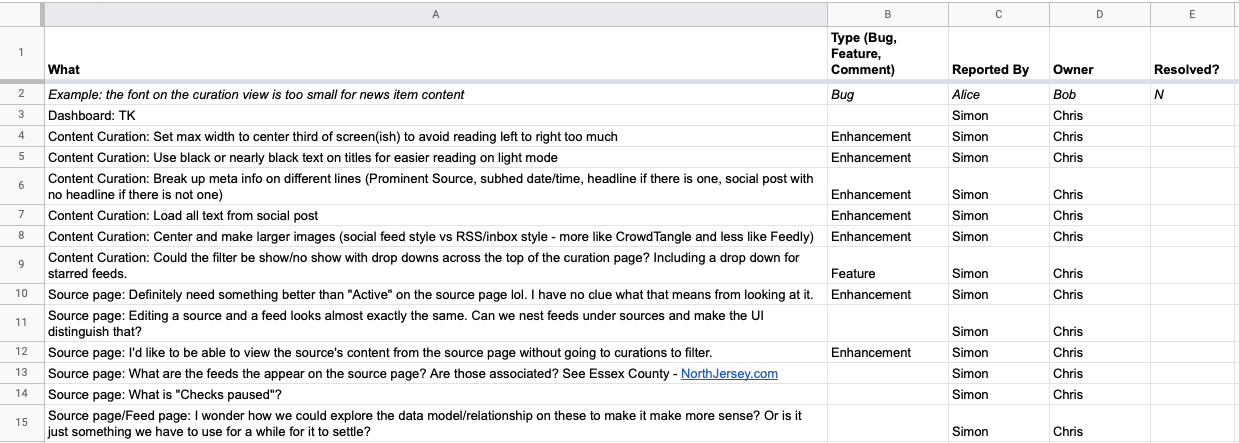
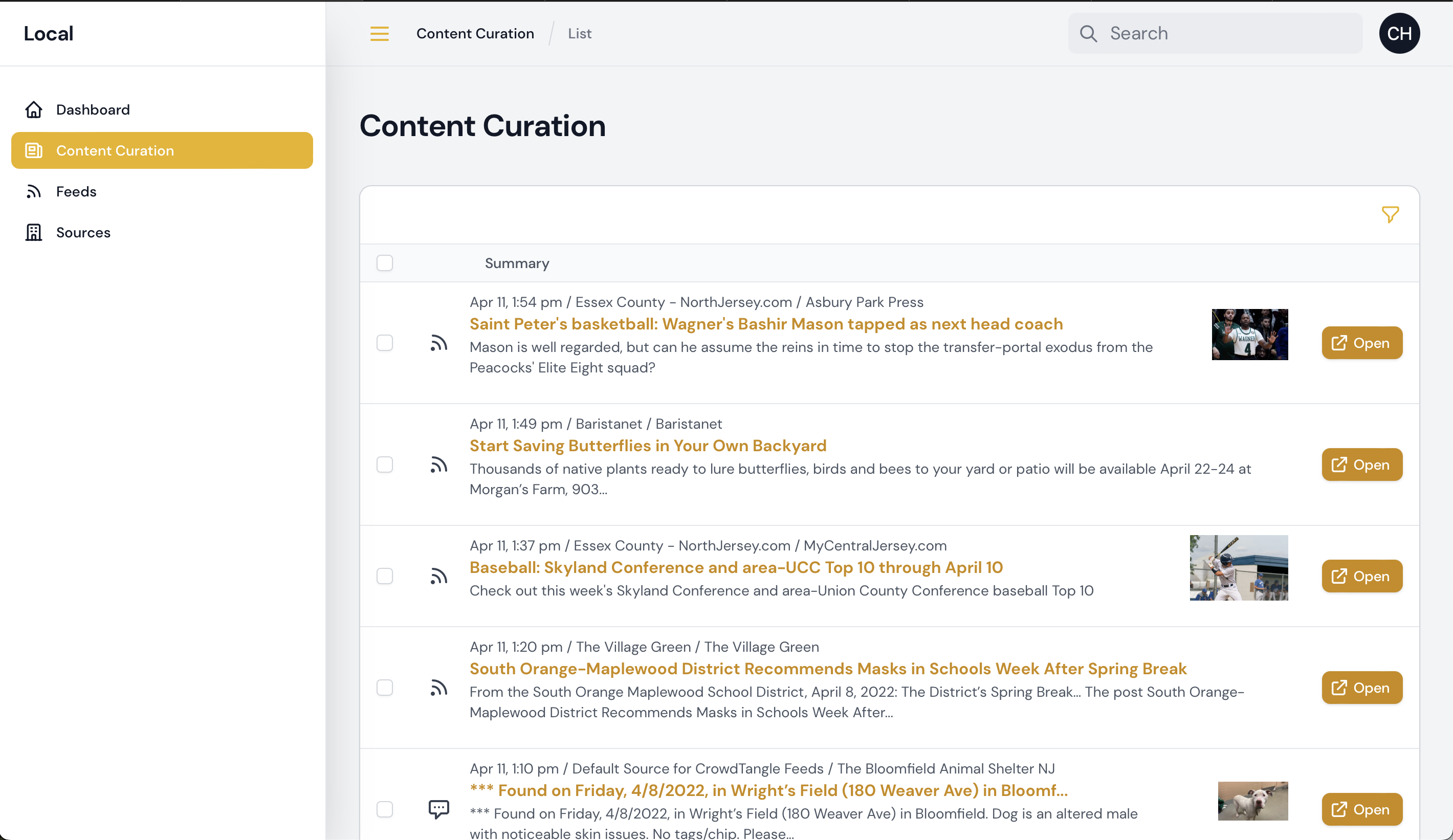
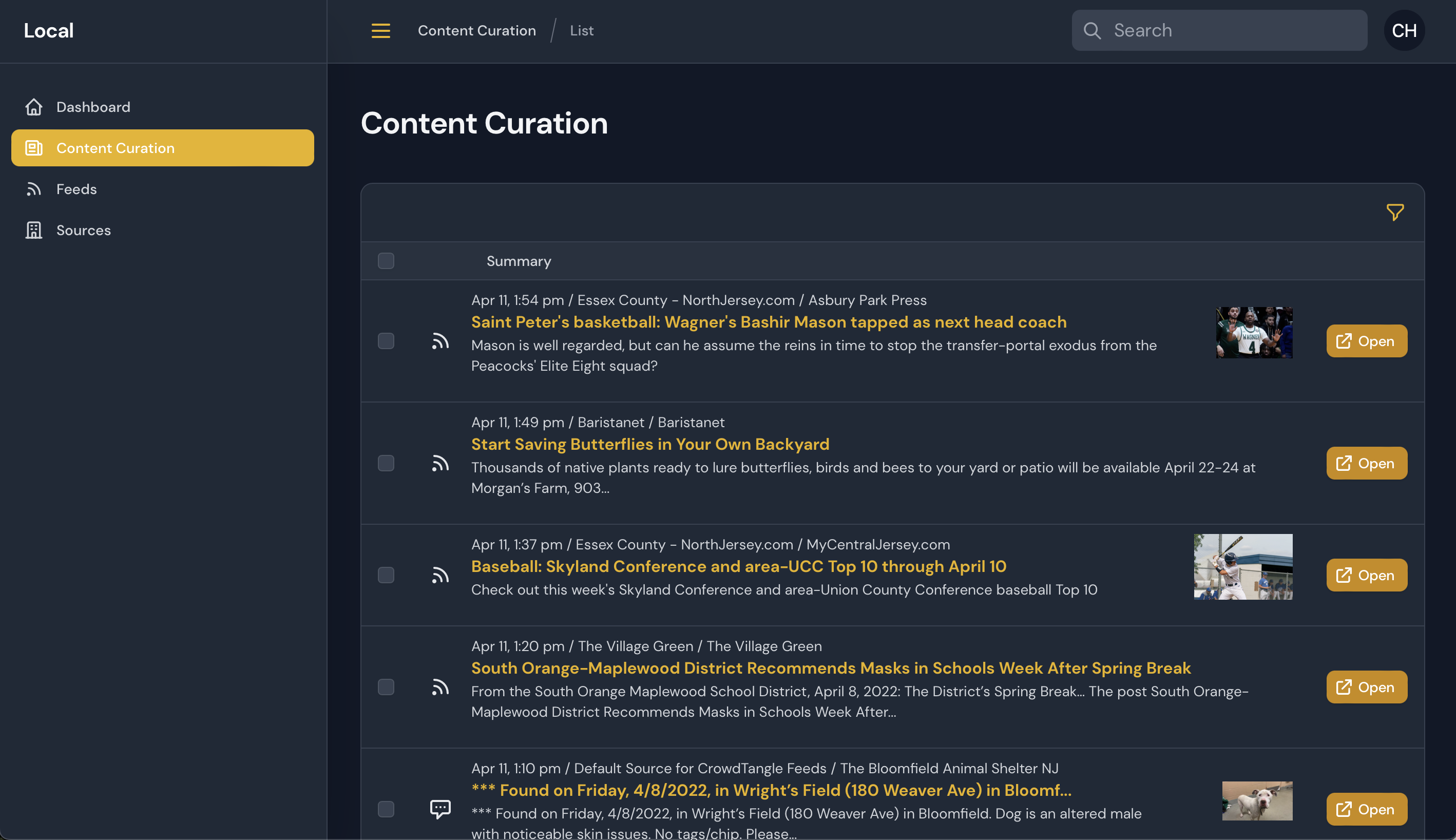
The first round of feedback that came in was a mix of big picture refresh questions about the data model, smaller aesthetic suggestions, and enhancements/requests around the content curation view:

Initial testing feedback from Simon

(You can continue to view the full feedback spreadsheet here.)

Some of those items were easily addressed through minor refinements, but others were more substantial, so on April 20th, Simon and I did a phone call to talk through them. Here are my rough notes from that conversation:

  • In general we’re going in the right direction, excited to get the “design quirks” ironed out
  • The responsive and mobile-friendly nature of the tool is good
  • Possibility of bringing in a collaborator/consultant Simon has worked with for additional UI feedback later on
  • Conversation about terminology, re-clarifying differences and relationships between Sources and Feeds, and how those will ultimately be managed as the tool expands.
  • Filtering options for the Content Curation view could expand forever, so need to focus on making sure the default view is as helpful as possible to the daily workflow of the news producer
  • Need to switch from notion of “starred” Feeds to a more general way to tag Sources, including a tag like “Top” or “Favorite” that might be selected by default.
  • Would be helpful to be able to quick-add sources from the feed edit screen

Following the call and the subsequent updates to the feedback spreadsheet to reflect our conversation, the plan was for me to deliver the refined version of the tool back to Simon and team by the end of that same week (so, April 22nd) so they could continue their testing.

You can see the ongoing work on the Laravel News Harvester package based on this feedback and other requests by viewing the commit history on GitHub. Again, this package and tool is now available for any other organization to use, benefit from and contribute to.

Continue reading Testing feedback and refinements

Status update for April 1

Since my last update, things have continued to move forward with my capstone project work:

Progress

  • I finalized and delivered the final application wireframes for the tool I’m building as a part of the capstone.
  • I wrote in detail about one particular aspect of the tool workflow and content curation process that we were finding challenging to figure out.
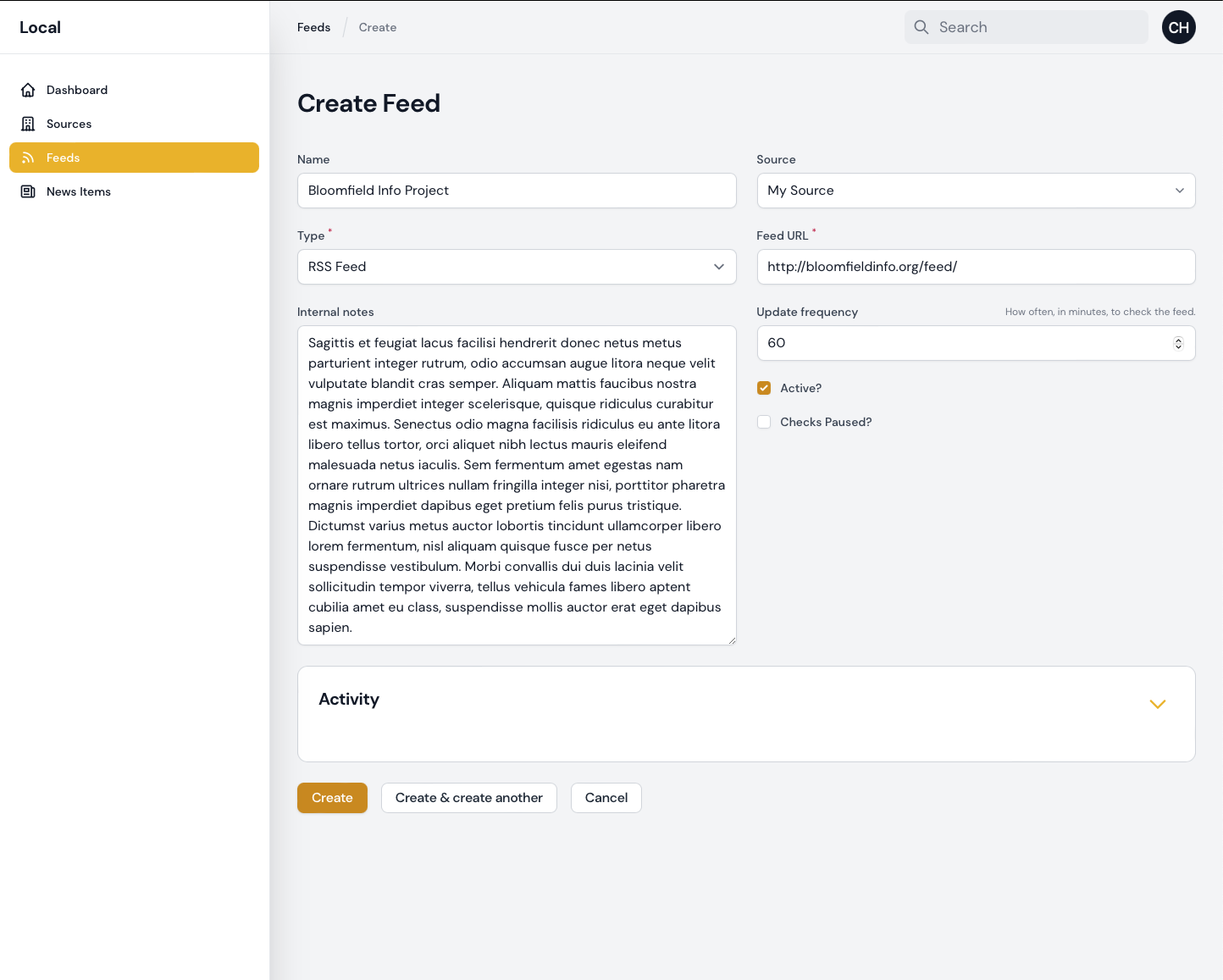
  • I’m deep into building the actual application software! Here’s an early screenshot from the “create a feed” workflow:

Screenshot of the "Create a Feed" screen

Plans

  • Continue to develop the software application and work toward delivering a first version for testing by the Bloomfield folks next week.
  • Based on feedback and real-world testing, make refinements and re-deliver, repeating that cycle as needed.

Problems

  • The Bloomfield team has had some challenges locating and contacting additional stakeholders for me to interview (at least one representative reader of the Daily Bulletin, and one person who has provided financial support to the project). Still hoping and expecting to be able to complete these conversations soon.
  • Some concerns have come up in the wider tech and journalism communities about the long-term plans for CrowdTangle, a tool that the Bloomfield team uses heavily in their news harvest and that I am working on integrating into the software. There’s nothing actionable on this for the moment but it may change some aspects of how that integration ends up working.
  • Some challenges lining up schedules between the Bloomfield team’s projects/priorities/travel as well as losing some time due to some family illness on my end mean that I’m again not quite where I want to be in terms of schedule. To compensate, I’ll be spending some of April beginning my write-up and summaries (originally intended for May).

Wireframes for initial and future project scopes

In this post I’ll share the finalized wireframes that I’ve developed for my initial capstone project work and that also illustrate the possibilities for future phases of development and software tooling. As expected, these wireframes reflect several rounds of wireframe creation, delivery, design discussions, decision-making, wireframe refinement, and then repeating that process.

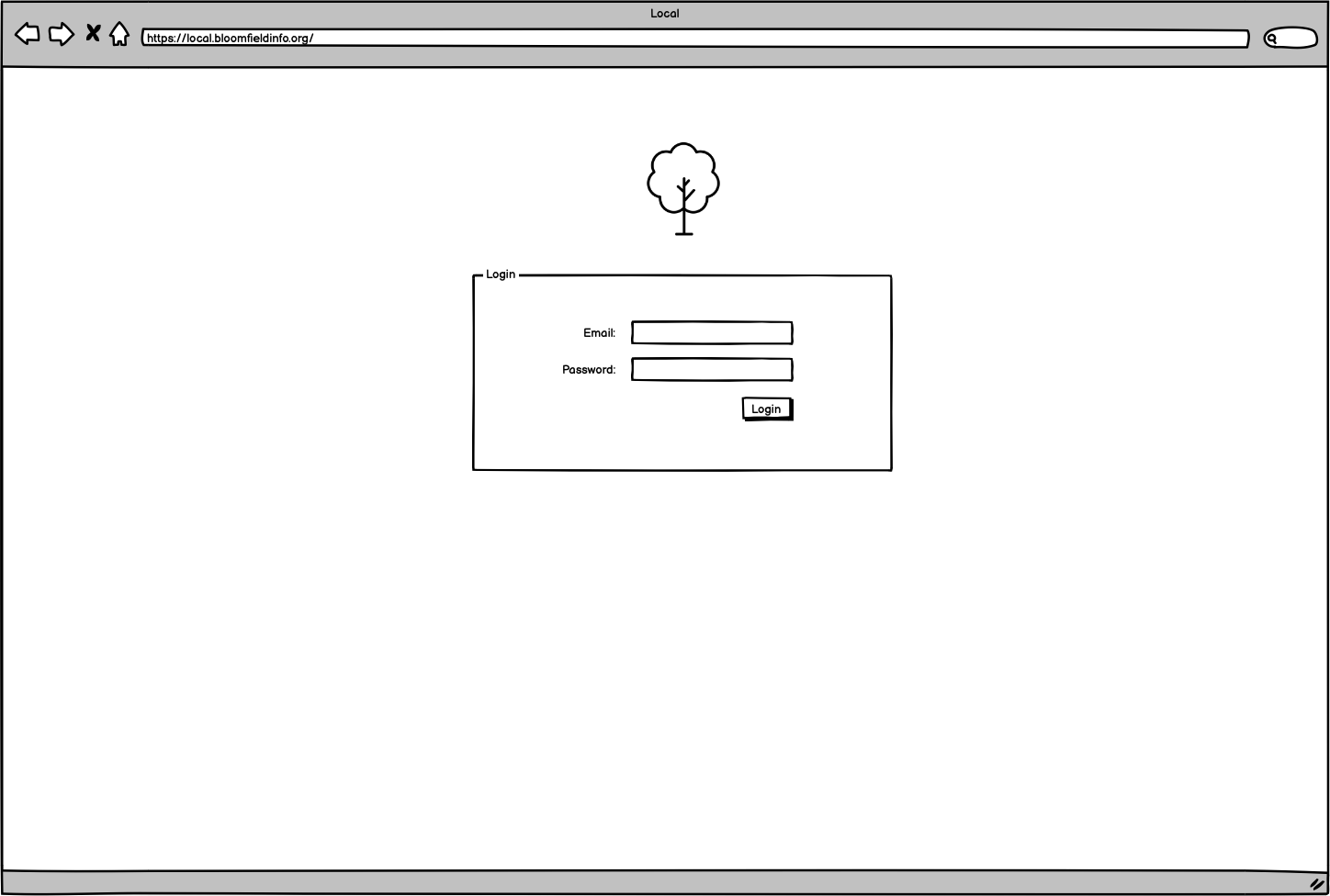
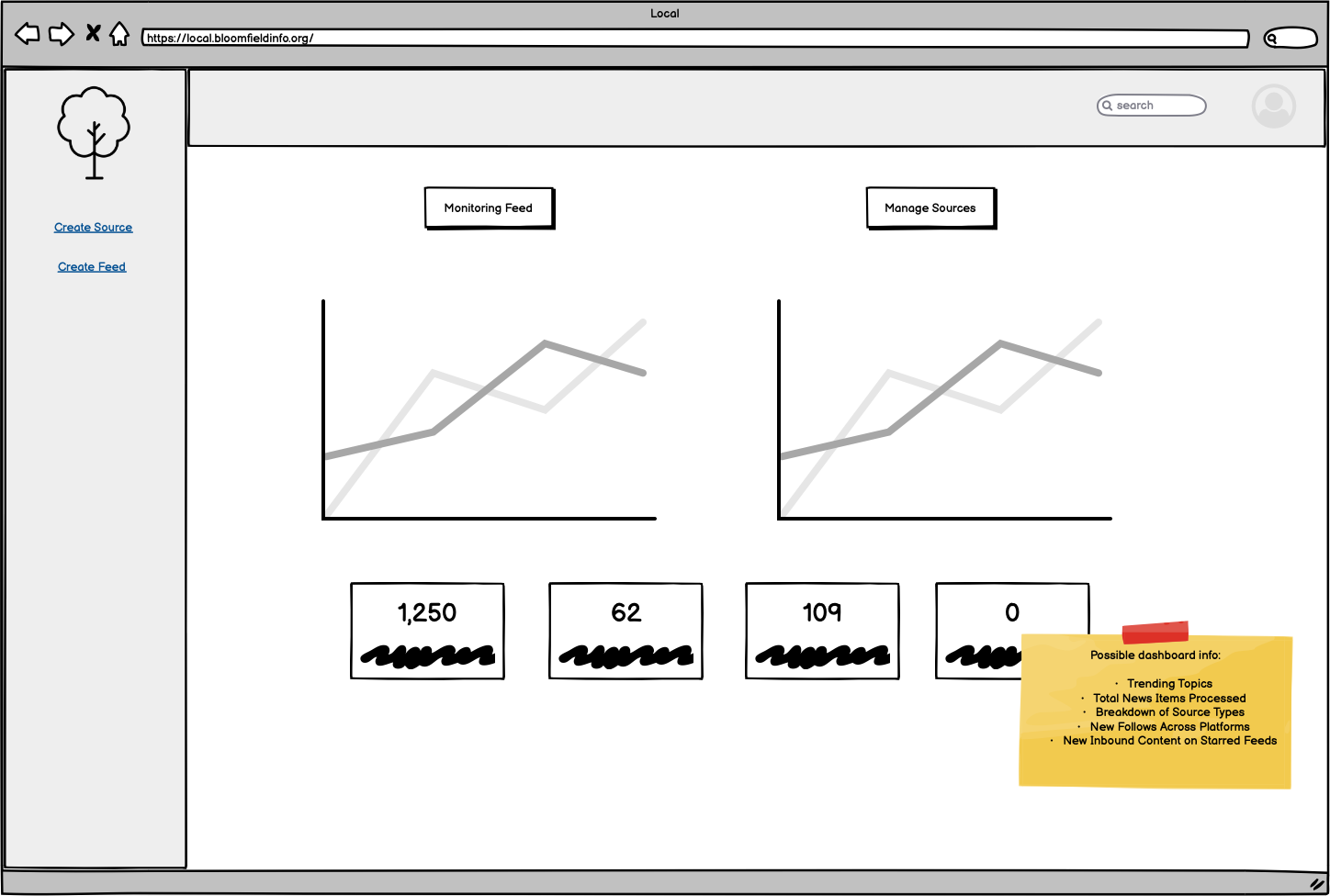
Here are the wireframes for the capstone project scope:

Allow users to login

Present the user with a dashboard

Continue reading Wireframes for initial and future project scopes

Status Update for Feb 28

It’s been about a month since my capstone project officially commenced, so here’s a quick summary of what’s taken place since then and what’s ahead. I’ll use a “progress, plans, problems” structure for these updates.

Progress

  • I set up this project website and posted my capstone project proposal, background information, planned deliverables (with feedback from the capstone committee incorporated) and a project timeline.
  • I documented some of the “side projects” that I have worked on for the Bloomfield Information Project related to the overall goals of my project.
  • I proposed and reviewed with Dr. Blom a list of questions for stakeholder interviews.
  • I’ve conducted three stakeholder conversations, one with project lead Simon Galperin (notes and analysis here) and two with members of the Bloomfield Information Project team (notes forthcoming).
  • I developed an initial data model for organizing the information that the new software tool will use and manage, reviewed it with Simon, and made some refinements based on feedback.
  • I posted related notes about a conversation and subsequent decision about the structure of the new application.
  • I began working on wireframe mockups of the new application, and am working to finish those for presentation and discussion.

Plans

  • Continue working on the wireframe mockups for the new application, and present those to the Bloomfield team so I can refine and finalize them. I expect to have them done this week (by March 4th).
  • Continue with stakeholder interviews, at least one representative reader of the Daily Bulletin, and one person who has provided (individually or as a part of an organization) financial support to the project. Simon is connecting me with those individuals and I hope to have those completed this week or next (by March 11) pending availability of the stakeholders.
  • Begin software development! It’s almost time to start building the new tool, with hopes of delivering an initial version for testing before the end of March. This will consume most of my time on the project in the weeks and months ahead.

Problems

We are a bit behind the timeline I’d originally imagined, but at this point there are no problems or concerns affecting the overall progress of the project.


Data Model

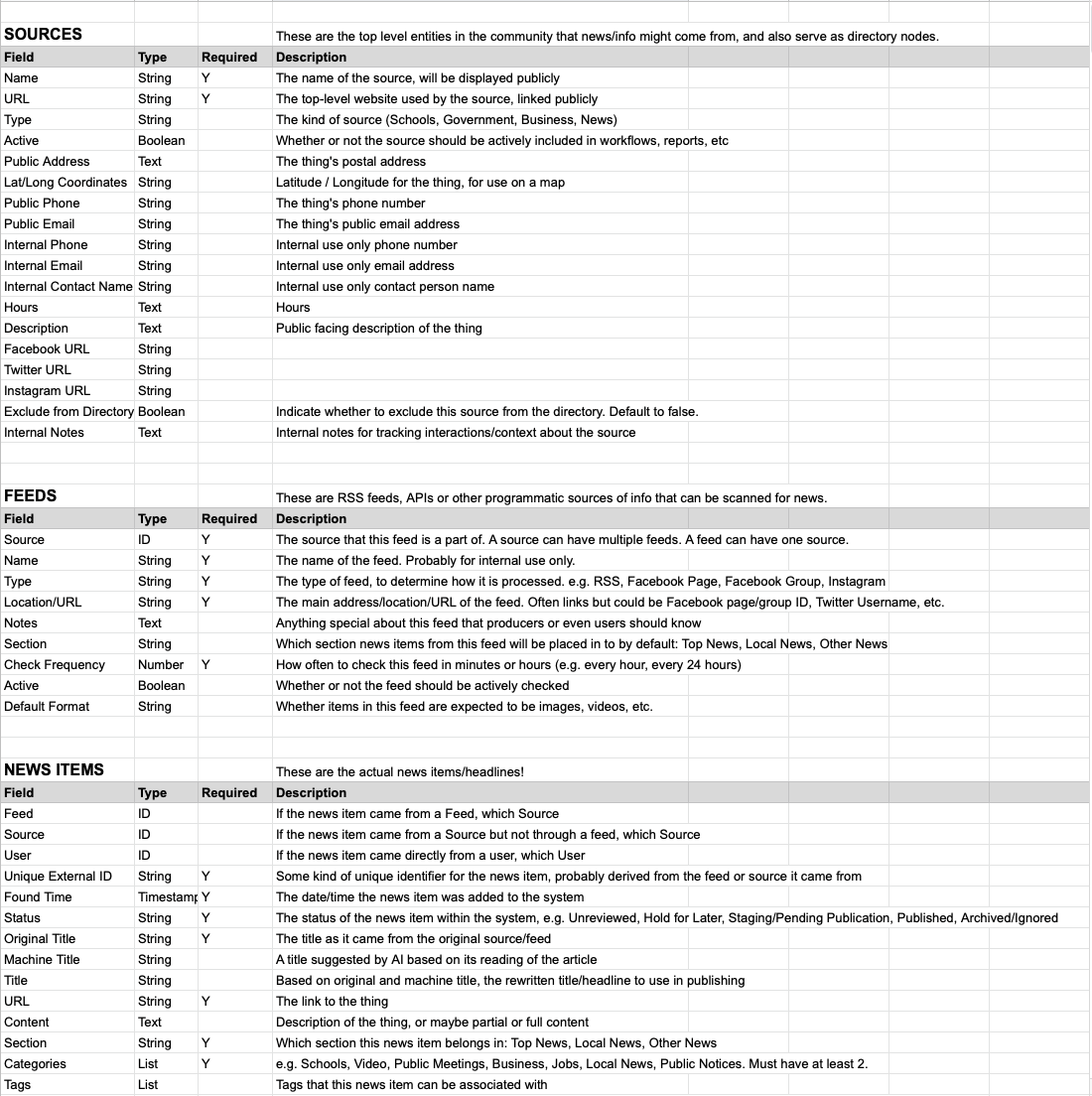
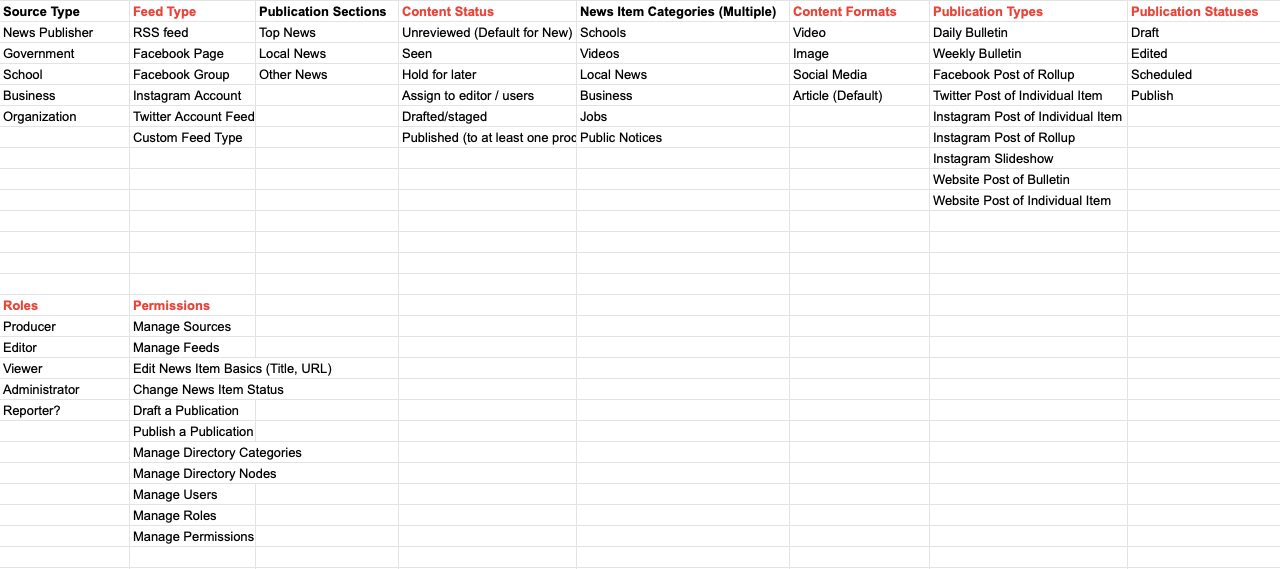
Based on our planning work and stakeholder conversations so far, I’ve been working with Simon to develop a data model for the new tool that will serve as the central dashboard for the news harvest workflow.

Here’s the Google Sheet and a few screenshots are included below:

A data model is a way of showing how all of the different data elements in the system will be organized, and how they will relate to each other. It’s a fun document to work on because you can focus on (and completely rearrange/rework) the core information that the system will manage without yet worrying about things like user interface, performance, features or other implementation details. Getting the data model “right” helps ensure that as the software is built, we’re clear on the core concepts of what goes where.

This document doesn’t capture every last detail and is likely to change, but it provides enough depth to allow us to begin mocking up the user interface and representing these concepts in a more concrete way. Those things will in turn be useful in further planning and stakeholder conversations.

Stakeholder questions for upcoming interviews

Soon I’ll be interviewing a few remaining stakeholders in the Bloomfield Information Project. I hope to interview at least one member of the BIP team, at least one representative reader of the Daily Bulletin, and one person who has provided (individually or as a part of an organization) financial support to the project.

These are the general questions I’m planning to use in those conversations; they are subject to further refinement based on feedback from my capstone advisory committee and others.

  1. Tell me about your background, how you got involved with the Bloomfield Information Project and/or the Community Info Coop, and how you work with / experience it today?
  2. What’s something that most excites or inspires you about the project?
  3. How would you describe the audience for the BIP/CIC? What do you think the BIP/CIC audience cares most about?
  4. In your mind, what does success look like for the BIP/CIC in the year ahead?
  5. What do you think are some of the biggest challenges or problems facing the project right now?
  6. What are some of the ways you’ve seen other news/community information organizations not be fully representative of the people they serve, and what opportunities do you see with BIP to improve upon that to be more representative and inclusive?
  7. If you had complete control over how the project works, what would you change or do differently?
  8. What’s something that has surprised you about the way the BIP/CIC project works?
  9. Is there anything else you’d like to share about your hopes for this project?

I will also add on additional questions as needed, mostly for the internal BIP team member conversation. These could include:

  • When you were first onboarded to the project, what was the most confusing or mysterious part of how it worked?
  • What part of the news harvest and production workflow feels most ripe for being improved or optimized?
  • What’s happening today that most helps or inhibits you in doing your work?

Stakeholder Interview: Simon Galperin
This post details my first stakeholder interview and conversation with project founder Simon Galperin.

I asked Simon about the evolution of their current process along with their software tools and setup.

They now scan over 200 sources per weekday to produce the Daily Bulletin. Currently a mix of RSS feeds, email newsletters, social media activity, various online websites and portals, and more. For news items they decide to include, they rewrite the headlines, do some general categorization and put them into a holding queue. This process, which they refer to as the “news harvest,” is all managed through a central Google Spreadsheet that is populated through a combination of software tools (e.g. a Chrome extension that can be opened while on a web page of interest, which in turn sends that information to Zapier, which then adds the information to the Google sheet) and manual entry.

Once the news has been harvested, they again use software tools to publish it to various distribution channels, including a WordPress-powered website, social media accounts, and an email newsletter distributed by Mailchimp.

Some additional follow-up information about news items becomes available after initial publication, such as video transcripts that come in from a third-party transcription service.

They sometimes also do original reporting which is posted on their WordPress site and then linked to in the bulletin.

Simon described the process as a prototype that is ripe for expansion and hopefully reuse in other communities. Simon emphasized that at its core, the goal of the process is to make sure the news being reported is representative of the entire community, and can be open to contributions and insights from people who may be traditionally excluded from the news gathering and community information distribution process. They also want to help people move past information overload while continuing to encourage community engagement. They make sure the sources are always cited and that they’re sharing information of practical value to residents and readers.

I asked Simon to say more about how they were exploring expansion and possible re-use of this toolset.

This effort is driven by the mission of the Community Info Coop, “making journalism and media more representative of the people it serves. We equip communities with the tools and information they need to design and sustain news and information ecosystems that strengthen democracy and increase civic engagement.”

Continue reading Stakeholder Interview: Simon Galperin