Status Update for Feb 28

It’s been about a month since my capstone project officially commenced, so here’s a quick summary of what’s taken place since then and what’s ahead. I’ll use a “progress, plans, problems” structure for these updates.

Progress

  • I set up this project website and posted my capstone project proposal, background information, planned deliverables (with feedback from the capstone committee incorporated) and a project timeline.
  • I documented some of the “side projects” that I have worked on for the Bloomfield Information Project related to the overall goals of my project.
  • I proposed and reviewed with Dr. Blom a list of questions for stakeholder interviews.
  • I’ve conducted three stakeholder conversations, one with project lead Simon Galperin (notes and analysis here) and two with members of the Bloomfield Information Project team (notes forthcoming).
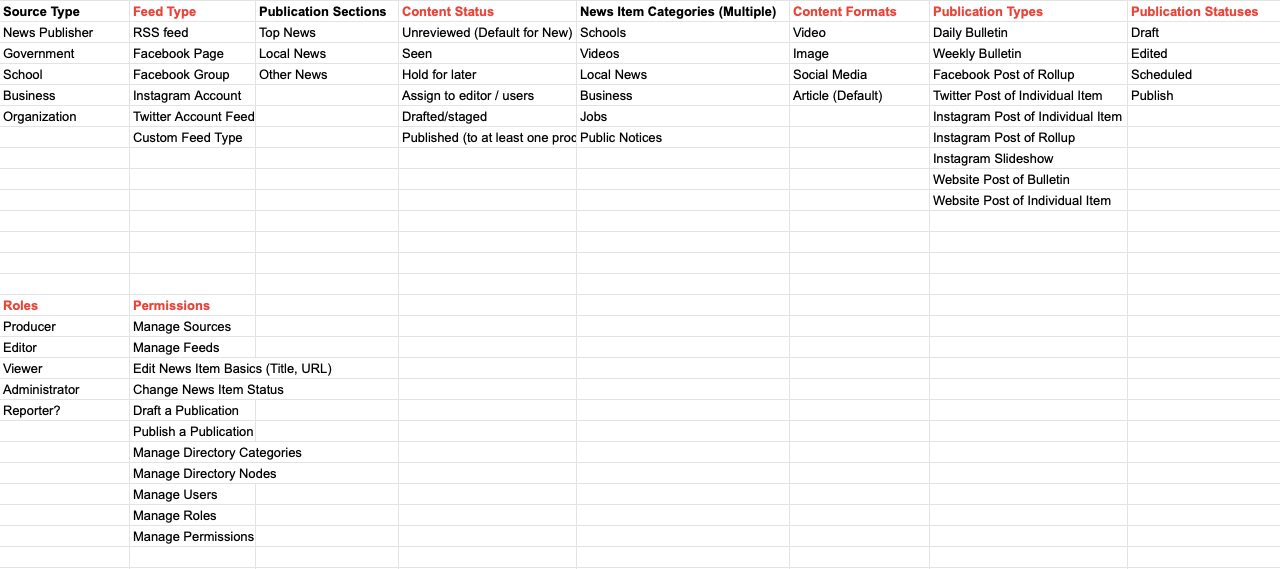
  • I developed an initial data model for organizing the information that the new software tool will use and manage, reviewed it with Simon, and made some refinements based on feedback.
  • I posted related notes about a conversation and subsequent decision about the structure of the new application.
  • I began working on wireframe mockups of the new application, and am working to finish those for presentation and discussion.

Plans

  • Continue working on the wireframe mockups for the new application, and present those to the Bloomfield team so I can refine and finalize them. I expect to have them done this week (by March 4th).
  • Continue with stakeholder interviews, at least one representative reader of the Daily Bulletin, and one person who has provided (individually or as a part of an organization) financial support to the project. Simon is connecting me with those individuals and I hope to have those completed this week or next (by March 11) pending availability of the stakeholders.
  • Begin software development! It’s almost time to start building the new tool, with hopes of delivering an initial version for testing before the end of March. This will consume most of my time on the project in the weeks and months ahead.

Problems

We are a bit behind the timeline I’d originally imagined, but at this point there are no problems or concerns affecting the overall progress of the project.
 

Consolidated or Distributed Site Structure?

One conceptual conversation Simon and I had recently was about how far to go in trying to consolidate the “news harvest” workflows and tools with the publishing and distribution workflows and tools.

At present, the workflow is distributed across many different tools and services. (A single news item that ends up in the Daily Bulletin publication might touch or be viewed in a web browser, a Zapier zap, a Slack channel, a Google Sheet, a WordPress publishing UI, a MailChimp publishing UI, a social media account and more.) While this allows for a lot of flexibility, it also creates a lot of places where the team has to think about how an item will appear, and how all of those services will connect with each other to make sure it does appear.

Building something new presents an opportunity to consolidate significantly, but we don’t want to go so far towards “one tool to rule them all” that the project can’t easily evolve or adapt to future needs. Clearly part of the project’s success has been how agile the team is and how quickly they can spin up a new tool or service to add value to what they’re doing. I imagine that this tradeoff is something newsrooms around the world have to consider on a regular basis.

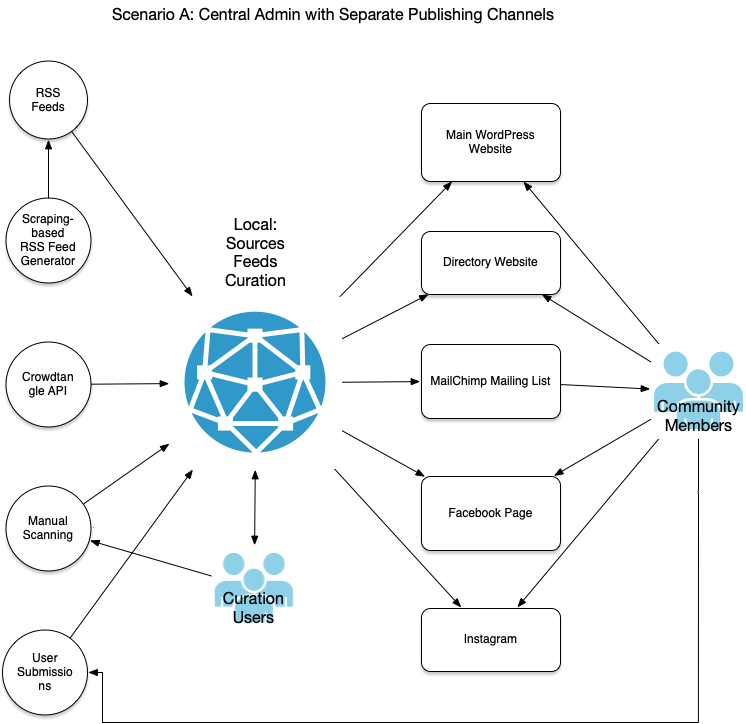
To help with the conversation, I tried to visualize two main scenarios I thought we were considering and put together some diagrams.

Scenario A is a centralized administrative tool, but still with separated out publishing channels:

The news harvest functionality on the far left all feeds into a central admin tool, which in turn publishes the curated and updated information to other tools hosted and managed elsewhere, which are in turn the public-facing experience that community members will interact with.

A key benefit of this approach are that we don’t have to reinvent some key functionality: WordPress already has content management system functionality covered, MailChimp already has mailing list functionality covered, and so on. By abstracting the information management workflows from publication and viewing, we keep our new tool focused and lightweight, making it easy to add new features to that part of the workflow.

Continue reading Consolidated or Distributed Site Structure?

Data Model

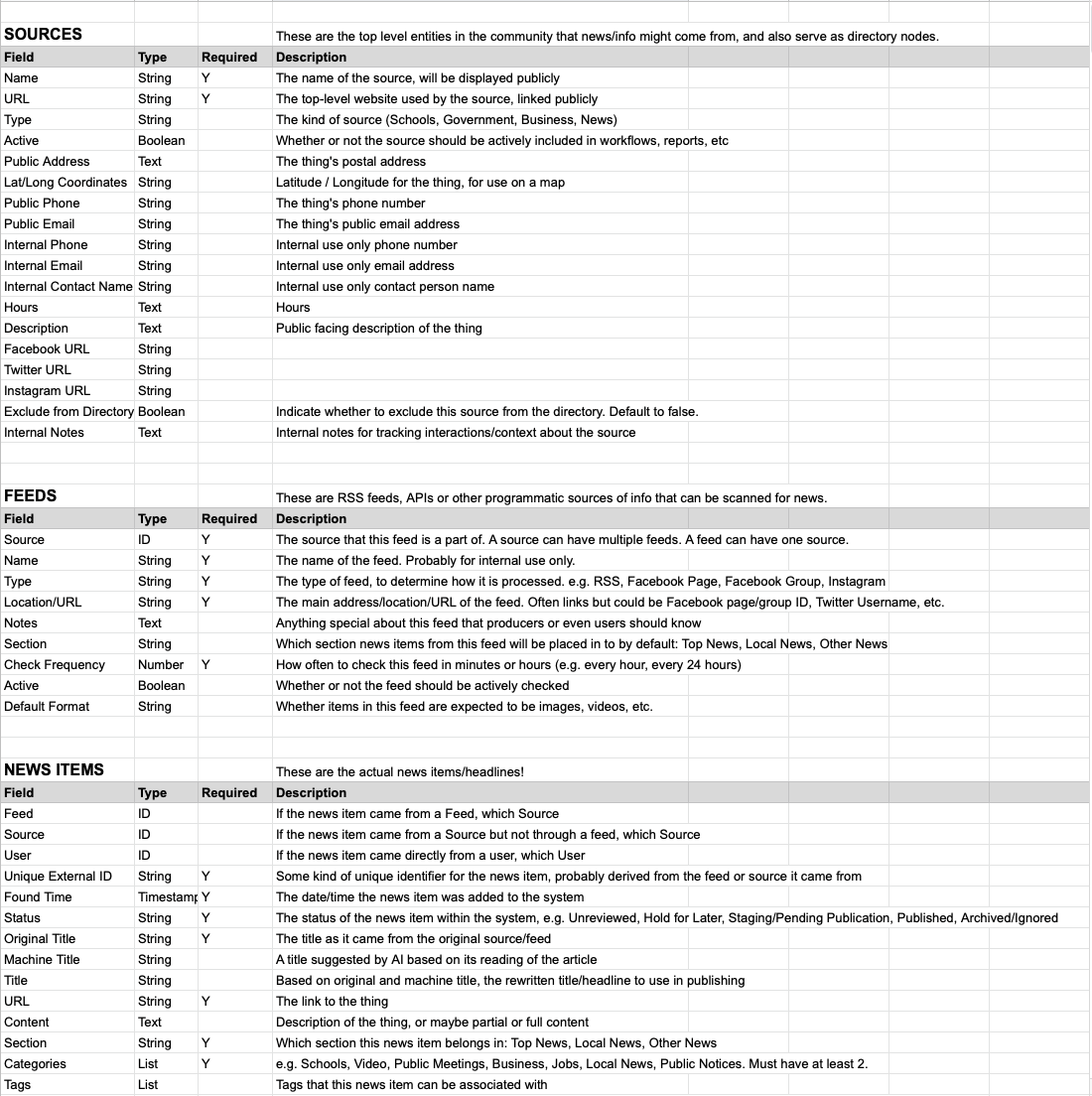
Based on our planning work and stakeholder conversations so far, I’ve been working with Simon to develop a data model for the new tool that will serve as the central dashboard for the news harvest workflow.

Here’s the Google Sheet and a few screenshots are included below:

A data model is a way of showing how all of the different data elements in the system will be organized, and how they will relate to each other. It’s a fun document to work on because you can focus on (and completely rearrange/rework) the core information that the system will manage without yet worrying about things like user interface, performance, features or other implementation details. Getting the data model “right” helps ensure that as the software is built, we’re clear on the core concepts of what goes where.

This document doesn’t capture every last detail and is likely to change, but it provides enough depth to allow us to begin mocking up the user interface and representing these concepts in a more concrete way. Those things will in turn be useful in further planning and stakeholder conversations.

Stakeholder questions for upcoming interviews

Soon I’ll be interviewing a few remaining stakeholders in the Bloomfield Information Project. I hope to interview at least one member of the BIP team, at least one representative reader of the Daily Bulletin, and one person who has provided (individually or as a part of an organization) financial support to the project.

These are the general questions I’m planning to use in those conversations; they are subject to further refinement based on feedback from my capstone advisory committee and others.

  1. Tell me about your background, how you got involved with the Bloomfield Information Project and/or the Community Info Coop, and how you work with / experience it today?
  2. What’s something that most excites or inspires you about the project?
  3. How would you describe the audience for the BIP/CIC? What do you think the BIP/CIC audience cares most about?
  4. In your mind, what does success look like for the BIP/CIC in the year ahead?
  5. What do you think are some of the biggest challenges or problems facing the project right now?
  6. What are some of the ways you’ve seen other news/community information organizations not be fully representative of the people they serve, and what opportunities do you see with BIP to improve upon that to be more representative and inclusive?
  7. If you had complete control over how the project works, what would you change or do differently?
  8. What’s something that has surprised you about the way the BIP/CIC project works?
  9. Is there anything else you’d like to share about your hopes for this project?

I will also add on additional questions as needed, mostly for the internal BIP team member conversation. These could include:

  • When you were first onboarded to the project, what was the most confusing or mysterious part of how it worked?
  • What part of the news harvest and production workflow feels most ripe for being improved or optimized?
  • What’s happening today that most helps or inhibits you in doing your work?

Stakeholder Interview: Simon Galperin

This post details my first stakeholder interview and conversation with project founder Simon Galperin.

I asked Simon about the evolution of their current process along with their software tools and setup.

They now scan over 200 sources per weekday to produce the Daily Bulletin. Currently a mix of RSS feeds, email newsletters, social media activity, various online websites and portals, and more. For news items they decide to include, they rewrite the headlines, do some general categorization and put them into a holding queue. This process, which they refer to as the “news harvest,” is all managed through a central Google Spreadsheet that is populated through a combination of software tools (e.g. a Chrome extension that can be opened while on a web page of interest, which in turn sends that information to Zapier, which then adds the information to the Google sheet) and manual entry.

Once the news has been harvested, they again use software tools to publish it to various distribution channels, including a WordPress-powered website, social media accounts, and an email newsletter distributed by Mailchimp.

Some additional follow-up information about news items becomes available after initial publication, such as video transcripts that come in from a third-party transcription service.

They sometimes also do original reporting which is posted on their WordPress site and then linked to in the bulletin.

Simon described the process as a prototype that is ripe for expansion and hopefully reuse in other communities. Simon emphasized that at its core, the goal of the process is to make sure the news being reported is representative of the entire community, and can be open to contributions and insights from people who may be traditionally excluded from the news gathering and community information distribution process. They also want to help people move past information overload while continuing to encourage community engagement. They make sure the sources are always cited and that they’re sharing information of practical value to residents and readers.

I asked Simon to say more about how they were exploring expansion and possible re-use of this toolset.

This effort is driven by the mission of the Community Info Coop, “making journalism and media more representative of the people it serves. We equip communities with the tools and information they need to design and sustain news and information ecosystems that strengthen democracy and increase civic engagement.”

Continue reading Stakeholder Interview: Simon Galperin

Side projects so far

In my initial time working with the Bloomfield Information Project recently, it became clear that there were some short-term, narrow-scope technical projects that could lead to immediate improvements in the workflows of the BIP team. My proposal references creating “software tools and functionality that solve some of the technical and user-facing needs of the project” and while most of that work is still yet to come, I don’t want to leave out some of those achievements already launched or completed in the form of smaller “side” projects I’ve worked on:

Custom RSS Feeds

So much of the daily workflow for the team revolves around scanning information sources and organizing what they find. In some cases that can be “simple” because the information comes in a standard format such as an RSS feed already available on a news provider’s website. But in other cases, that information is hard to reach, and may require several steps, such as logging in to an account, performing a search, filtering and scanning the results, copying and pasting the details.

So, for those harder cases where it seemed like the information should be available in a programmatic or structured way but wasn’t, Simon and I started looking at how we could use software to make things simple.

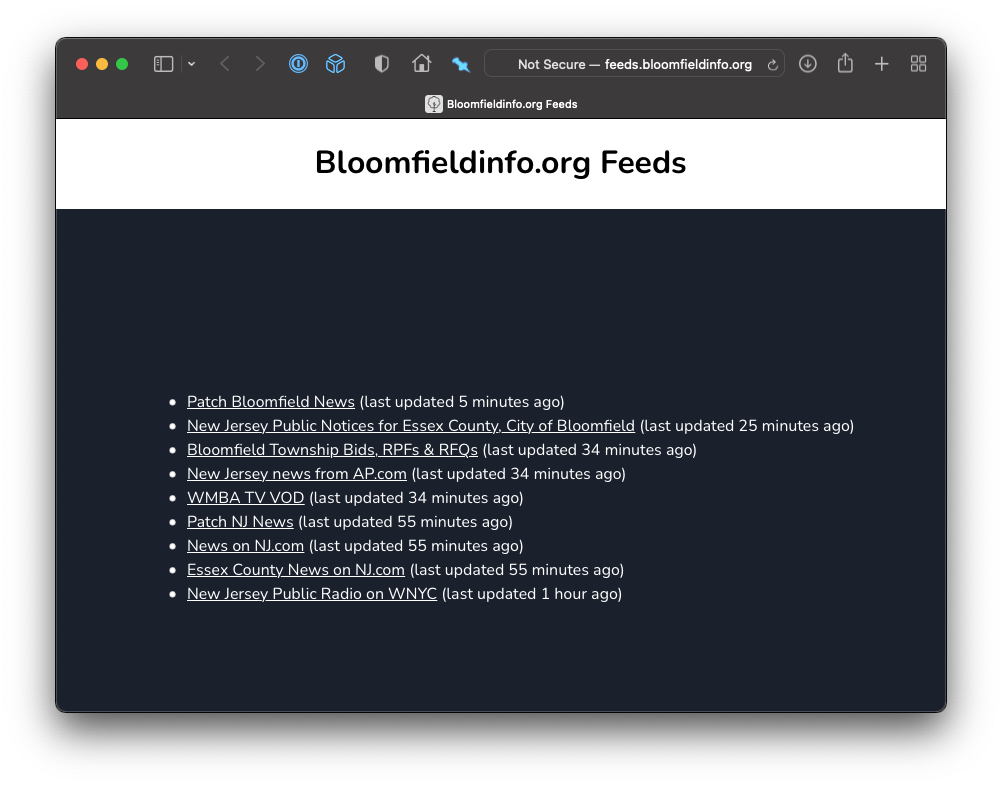
The end result was a Laravel application I created that scrapes or otherwise converts publicly available information into a useful RSS feed. It makes use of another Laravel package I’d already created for personal projects, laravel-feedmaker. The end result is a simple website that hosts these automatically updated RSS feeds:

We set it up to live at feeds.bloomfieldinfo.org and it currently contains feeds for a variety of sources: local and regional news sites, a public notice database, a government RFP database, government meeting videos, local news from national news websites, and more. In each case the feed links the BIP team member directly to the item on the original source, so we’re not republishing or copying any content directly.

Then, the team member (or even other users out on the Internet) can use their own RSS reading tools (Feedly, Zapier, or other) to process and work with those feeds just like they do the rest of the sources they scan. Simon tells me this evolution has already been helpful in their daily workflow.

Continue reading Side projects so far

Deliverables

Based on my original proposal and the feedback I received during the proposal defense meeting that happened this past Monday, here’s an updated list of my planned deliverables for this project:

  1. Summaries and analysis of stakeholder interviews (2-5 pages)
  2. Summaries and analysis of design thinking sessions (2-5 pages)
  3. Any and all mockups along with notes about how they were presented and received (2-3 pages)
  4. Software packages via links to GitHub repositories or zip file attachments, along with summaries of what each major software tool or library does (3 pages)
  5. Summaries and analysis of usability and user experience testing sessions (3-5 pages)
  6. Links to published open source software for re-use by other communities (1 page)
  7. A video walkthrough or presentation that visually shows what has been built and how it might be useful to other communities
  8. A written review of the project and our collaboration from Simon Galperin (1-2 pages)
  9. Project summary and discussion (2 pages)

Background Information

Here’s some background reading that helped inform my capstone proposal and that provides context on the people and projects involved:

This Twitter thread from Simon covers a lot of ground:

Some of the links mentioned in the thread:

Here’s a bit more about the Bloomfield Information Project and the existing Zapier-powered workflow that they use for their news harvest.

Here’s the It’s All Journalism podcast interview where I first heard Simon and learned about these projects.

After listening to the conversation, without this capstone project even on the radar, I emailed Simon to express excitement and affirmation for his work, and to share a bit about my own projects and background.

One part of that background is that since 2011 I’ve been maintaining a web-based tool in my own community that aggregates and shares local news headlines and other information. I recently re-launched it at WayneCounty.info and continue to build on it today. My main goal with it is to increase community awareness about news, events and happenings in the area, increase civic engagement based on that information, and help people detangle their awareness and engagement from social media platforms that incentivize problematic behaviors and the spread of misinformation.

My approach has been very focused on software automation. Simon’s has been focused on human-led curation with software tools to scale that process. There’s a lot to explore at each end and in between.

Simon and I set up a call on August 4, 2021 to chat more, and found we had a lot of shared interests and goals in local news production models. We continued to exchange emails and geek out over tools and workflows for the following months, and the conversation continued from there. At the end of 2021 I proposed collaborating as a part of my capstone project, and here we are!

Capstone Proposal

Here’s the abstract from my capstone project proposal:

The availability of comprehensive, representative sources of local news remains core to a community’s level of civic engagement, whether in local politics and elections, community improvement efforts, or general public life. While many business models for gathering, producing and publishing local news are evolving, and some succeeding, they still often have significant gaps, whether in efficient use of already available community information, inclusiveness of diverse voices and perspectives, or financial sustainability and the model’s repeatability or scalability.

I propose to explore one of these new models and the intersections of local journalism, software publishing tools, civic engagement and improving diversity and inclusion by combining my studies in the Ball State Journalism program with my skills and experience in web software application development to research and contribute improvements to an existing community news service. By doing this I anticipate not only helping that news service to thrive, but also to help establish a template and methodology that could be repeated in other communities where a sustainable local news model is still missing.

You can read the full proposal here (December 17, 2021 version. PDF).

Welcome!

This website is dedicated to my creative capstone project happening during the Spring and Summer terms of 2022 as a part of my graduate studies in journalism at Ball State University.

I’ll use this site to post information about the capstone project, updates and progress along the way, as well as related notes and links related to the topics being explored in the project.

Some posts that contain sensitive information may require a password for access; contact Chris for that information.